LRC-TriCEPS target identification on living cells – can it be replaced by AI?
A simple test on 4 real-life examples
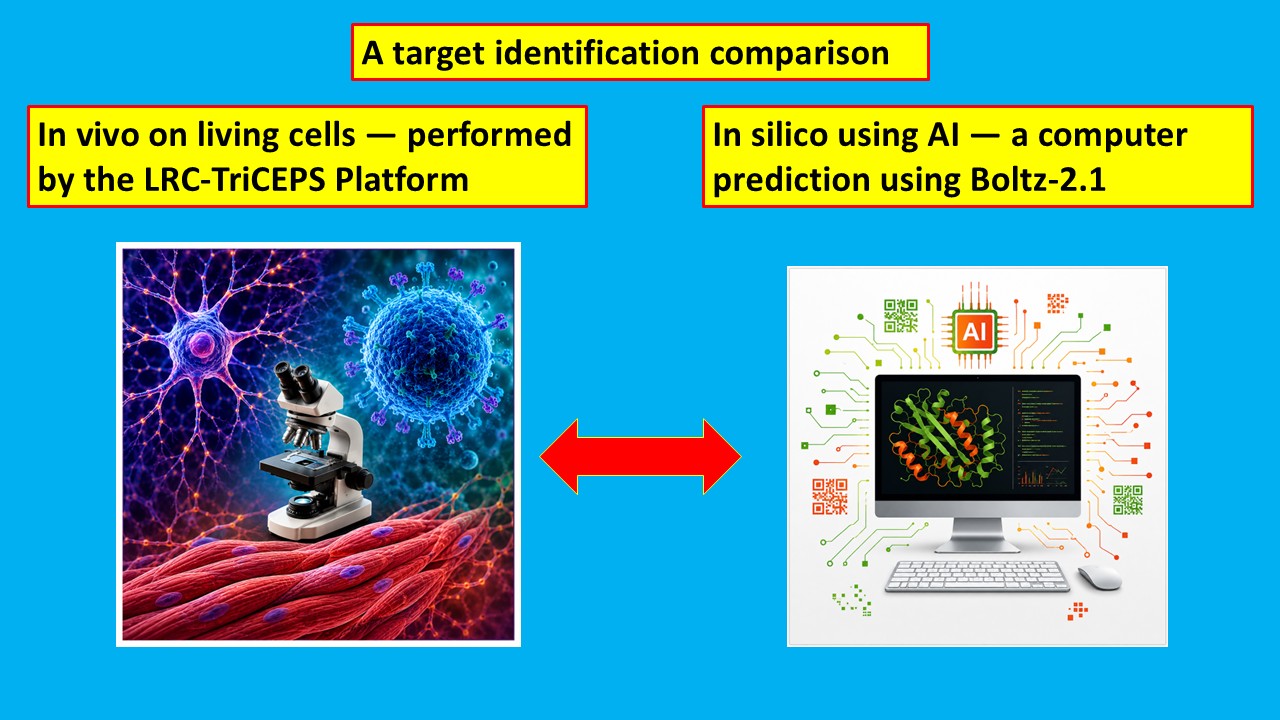
AI-based protein-protein interaction models are becoming more common. A question comes up more often now: could these models replace experimental target discovery platforms like LRC-TriCEPS?
We tested this directly. LRC-TriCEPS identifies targets on living cells, primary cells and cell lines, kept in their correct biological state, for example activated T-cells in suspension or adherent cells directly on the plate. We selected four independent LRC-TriCEPS projects with a published, independently validated target. The four examples cover different levels of difficulty, from a classical, well-known interaction to one of the hardest problems in the field: a pH-dependent immune-checkpoint interaction that took years to identify.
We chose Boltz-2.1 for this test. Boltz-2.1 is an open-source AI model built specifically for protein-protein structure prediction. It supports full protein-complex prediction and modified residues. Its developers report accuracy close to AlphaFold3. This makes it a fair and current test of what AI can do today, not an outdated comparison.
We also simplified the task in favor of AI. LRC-TriCEPS works without a hypothesis against the whole proteome, several hundred to a thousand detected proteins per experiment, on living cells. For this test, we gave Boltz a shortlist of only ten proteins per project: the validated target plus nine other proteins detected in the same experiment. One correct answer out of ten, not the real discovery problem.
Even with this easier setup, the result was mixed. AI correctly ranked the validated target first in two of the four projects. In the other two, AI missed the true target. In the VISTA-PSGL-1 project, AI ranked the confirmed target last out of ten.
Our conclusion: AI can be used as an initial help once an experimental shortlist already exists. It cannot replace hypothesis-free discovery on living cells. A low AI score is not proof that a real target is wrong.
Read the full benchmark report below.
P.S. This comparison was done with the help of AI, ChatGPT and Claude. For tasks like data handling, checking, and writing, AI is a great and wonderful tool. Our conclusion above is specific to target discovery on living cells, not a general statement about AI.